alurail alurail
Home & Hub Live Journey Map Timetables Route Search Special Trains (KLB) Train Directory Fleet Database Station Directory Facilities & Depots Operating Areas Safety & Incidents Updates & News Photo Gallery alurail pass
User Suite
Map Home Timetables Fleet
alurail alurail
Hub / Home Directory & Insights
Live Journey Map Crowdsourced Live Journey
Timetables Train Schedules
Search Routes Direct & Transit Finder
Extraordinary Trains (EOT) Extraordinary Trains
Train Directory Master Train Fleet
Fleet Database Rolling Stock Info
Stations Facilities & Hubs
Facilities Depots & Workshops
Operating Areas Daop & Divre
Incidents & Safety (EOE) Historical Rail Incidents
Updates & News Railway Dispatches & Insights
Photo Gallery Curated Collection
alurail pass Supporter Perks
About alurail Platform Info & Vision
Sign In / Account
Back to Updates • History, Train Profile
Live Radar alurail Pass Submit Photo
Live Journey / Updates / History of KA Mutiara Selatan and Mutiara Utara: Technical Evolution, GAPEKA 2026 Transition, and Java Rail Legacy
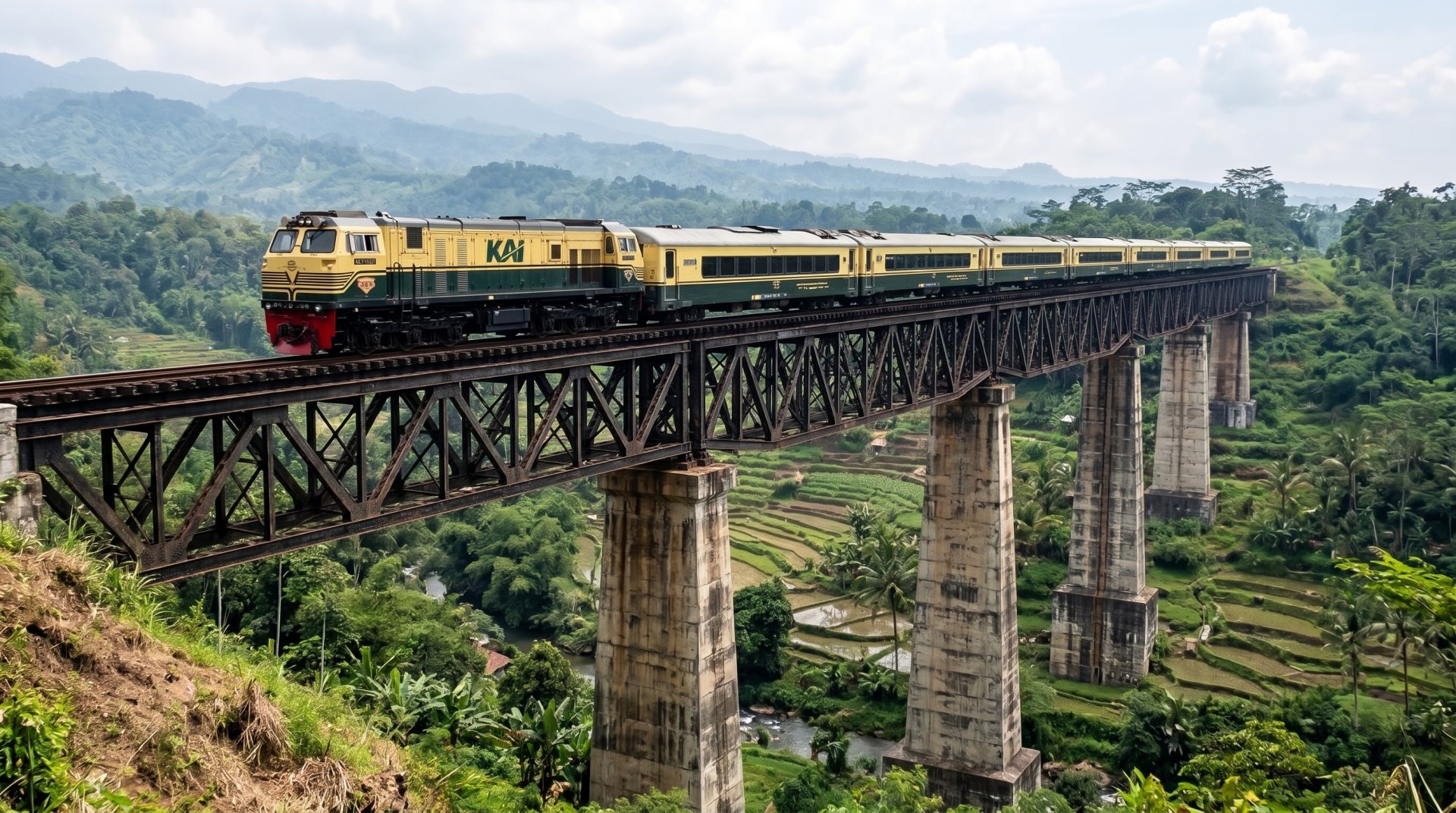
History Train Profile 28 November 2026 • Updated 28 November 2026

History of KA Mutiara Selatan and Mutiara Utara: Technical Evolution, GAPEKA 2026 Transition, and Java Rail Legacy

Comprehensive research on Indonesia's historic Mutiara family: Mutiara Utara (1971–1995) and its successor KA Sembrani, plus Mutiara Selatan's 54-year survival into GAPEKA 2026 (KA 95/96), SSG1 vs SSNG audit, Priangan mountain grades, and safety investigations.
alurail Editorial Team
Staff Writer & Rail Researcher • 680 views
History of KA Mutiara Selatan and Mutiara Utara: Technical Evolution, GAPEKA 2026 Transition, and Java Rail Legacy
Table of Contents
  1. 1. 1. Genealogy of the Mutiara Family & Java's North–South Divide
  2. 2. 2. History of KA Mutiara Utara (1971–1995) & KA Sembrani
  3. 3. 3. Four Phases of KA Mutiara Selatan (1972–2026)
  4. 4. 4. Rolling Stock Audit (SSG1 vs. SSNG) & East Priangan Mountain Grades
  5. 5. 5. GAPEKA 2026 Schedule (KA 95/96), Fares & Competition
  6. 6. 6. Safety Record & Forensic Investigation Lessons (1974–2026)
Executive Summary — The Mutiara Family (1971–2026)

KA Mutiara Utara (1971–1995) and KA Mutiara Selatan (1972–present) formed the flagship express pillars of the "Mutiara Family" during the PNKA-to-PJKA transition. While Mutiara Utara retired in October 1995 to regenerate as KA Sembrani, Mutiara Selatan has endured past 54 years as Indonesia's second-oldest passenger train still carrying its original name after KA Bima.

Under GAPEKA 2026 (effective December 1, 2026), Mutiara Selatan renumbers from KA 71/72 to KA 95/96 (Bandung–Surabaya Gubeng, 696.347 km). Westbound KA 95 cuts 20 minutes to 10h 45m while adding a new commercial stop at Jeruklegi; eastbound KA 96 adds 27 minutes to 11h 09m (7-minute stop at Nagreg, 16-minute stop at Kebumen). Official Daop 8 PPID schedules and PT INKA's 612-coach contract press release confirm regular sets still run Stainless Steel Generation 1 (SSG1) coaches (520 seats: 4 K1 + 4 K3 Premium), not SSNG.

Mutsel Operating Span
54+ Years
In service since August 17, 1972
GAPEKA 2026 Nos. & Time
KA 95 / 96
10h 45m (−20m) & 11h 09m (+27m)
Active Regular Fleet
520 Seats (SSG1)
4 K1 (200) + 4 K3 Premium (320)
East Priangan Grade
25 Permil (2.5%)
Cipeundeuy +772m asl (10m brake check)

1. Genealogy of the Mutiara Family & Java's North–South Divide

Named after Indonesia's Pinctada pearl oysters symbolizing top-tier rail prestige, the Mutiara brand emerged in 1967–1968 before crystallizing into three strategic trunk services in the early 1970s: KA Mutiara Utara (1971–1995, Jakarta Kota–Semarang Tawang–Surabaya Pasarturi), KA Mutiara Selatan (1972–present, Bandung–Tasikmalaya–Kroya–Yogyakarta–Surabaya Gubeng), and KA Mutiara Timur (launched March 6, 1973, Surabaya–Banyuwangi, famous for its Surabaya–Denpasar bus through-ticketing with CV Rama and later DAMRI, and appearance in the 1980 Warkop DKI film Mana Tahan). Their diverging fates reflect geography: the North Coast is flat and fully double-tracked (727 km since 2014), whereas the Southern Line combines high-speed double track with steep, winding single-track mountain grades across Cicalengka, Nagreg, Cipeundeuy, Tasikmalaya, Banjar, and Kroya. Methodologically, three archival nuances apply: (1) Mutiara Utara's 1971–1995 timetables and rupiah fares are reconstructed from contemporary newspaper ads and GAPEKA 1989 formations; (2) primary sources record one-day variations for Mutiara Utara's launch (Sept 26 vs. 27, 1971) and Sembrani's debut (Oct 1 vs. 16, 1995); and (3) KNKT's 2011 Langen collision findings (KNKT.11.01.01.02) are cited via KNKT index metadata and academic safety studies.

Parameter KA Mutiara Utara (Historic & Successor) KA Mutiara Selatan (1972–2026)
Launch DateSept 26, 1971 (Berita Buana) / Sept 27, 1971 (Roda Sayap)August 17, 1972 (27th Independence Day)
Status (Nov 2026)Discontinued Oct 1995; replaced by KA SembraniActive (2nd oldest original-name passenger train)
PredecessorKA Limex Gaja Baru (Sept 28, 1968)None (positioned above economy KA Badrasurya)
Primary RouteJakarta Kota–Semarang–Surabaya Pasarturi (Sembrani: GMR–SBI 720.109 km)Bandung–Surabaya Gubeng (696.347 km); extended to Malang (2016–20) & Gambir (2019–20)
Class EvolutionClass I → Mixed I–II → 1990 Exec → Exec A/B → Satwa (Sembrani) + Luxury SleeperExec–Bus (1972) → Full Bus (1982–84, 1995/99–2016) → Eco Plus (Sept 2016) → Bus → Exec–Bus → Exec–Eco Premium SS (2019–)
LocomotivesBB200 → BB304/BB301 (1976–95); Sembrani: CC206BB301 (1972–77) → CC201 (1977) → CC203 → CC206 (~100%)
Modern RuntimeSembrani: 8h 25–30m (84.72–85.56 km/h)GAPEKA 2026: 10h 45m (KA 95) & 11h 09m (KA 96)

2. History of KA Mutiara Utara (1971–1995) & KA Sembrani

The roots of KA Mutiara Utara trace back three years before the "Mutiara" name was permanently adopted. On September 28, 1968, PNKA launched a prestigious overnight express named Gaja Baru Malam—popularly known among retired PNKA staff as KA Limex Gaja Baru (Limited Express)—running Jakarta Kota–Surabaya Pasarturi via Semarang with a Class I formation of 6 AW + 1 FW + 1 DW. During the 1971 timetable overhaul coinciding with PNKA's institutional transition to PJKA, the operator rebranded Limex Gaja Baru into KA Mutiara (recorded in Berita Buana's Sept 25, 1971 advertisement as launching September 26, 1971, and in Roda Sayap archives as September 27, 1971). The displaced Gaja Baru Malam name was reassigned to the trailing Kilat Malam train, creating KA Gaya Baru Malam Utara. For nearly its first year, the train operated simply as KA Mutiara until "Utara" (North) was added following the August 1972 debut of KA Mutiara Selatan.

Carrying top-priority timetable numbers KA 3 and KA 4 in GAPEKA 1989, Mutiara Utara consistently held the highest tier within the Mutiara Family. Contemporary PNKA advertisements highlighted air conditioning, audio entertainment, reclining seats, and included dinner, breakfast, and snack service. In its first decade, it typically ran 5–6 Class I coaches (AW), 1 dining car (FW), and 1 baggage car (DW), relying on bogie-mounted axle generators and storage batteries before dedicated generator cars (BP) arrived in the 1980s. Throughout the PJKA era, Mutiara Utara also utilized ex-Bima Class I SAGW sleeping cars (built by Waggonbau Görlitz in 1967) before all remaining sleepers were retired and converted into seated executive coaches in mid-1995. In the mid-1980s, PJKA broadened market reach by introducing mixed Class I–II (Executive–Business) consists (8 K1 + K2 + M1 + BP in GAPEKA 1989), and on June 9, 1990—alongside KA Bima—it inaugurated PJKA's new-generation Executive class (briefly split into Executive-A and Executive-B from March 11, 1992 until 1993–1994). Axle-load limits on the North Coast required light-axle BB200 (EMD G8U6, 950 HP, changing locomotives in Semarang and maintained at Sidotopo rather than Pasarturi) and later West German BB304 (13-ton axle load, 1,560 HP) diesel-hydraulic locomotives until 1995. Following the 1994 KA Suryajaya experiment (which achieved 95–100% load factors and paved the way for JS950 Argo Bromo on July 31, 1995), Perumka retired the Mutiara Utara name in October 1995 (October 1 or October 16), replacing it with KA Sembrani—which today runs GMR–SBI in 8h 25–30m with Stainless Steel coaches and 18-seat Luxury Sleeper cars (since June 1, 2025), alongside rival KA Anggrek (shortened from Argo Bromo Anggrek on May 9, 2026).

3. Four Phases of KA Mutiara Selatan (1972–2026)

Launched on August 17, 1972 to commemorate Indonesia's 27th Independence Day, KA Mutiara Selatan (popularly abbreviated KA Mutsel) was positioned as the southern counterpart to KA Parahyangan and nicknamed "King of the South" for bringing overnight express comfort to East Priangan above economy-class KA Badrasurya. Its 54-year evolution unfolded across four distinct phases:

  • Phase 1 — PJKA Glory & Early Fluctuations (1972–1994): Debuted on Bandung–Surabaya Gubeng with mixed Executive and Business classes (2 AW + 4–5 BW + 1 FW + 1 DW) hauled by West German BB301 diesel-hydraulic locomotives before transitioning to GE CC201 units in 1977 as track strengthening progressed. Like Mutiara Utara, it also carried SAGW/SBGW sleeping cars before sleeper services ended nationwide. After receiving new Japanese-built K2 coaches in 1982, it briefly ran as Full Business until Executive class was restored in 1984 (operating as KA 5–6 with 2 K1 + 5 K2 + M2 + BP in GAPEKA 1989).
  • Phase 2 — Displaced by Turangga & Argo Wilis into Full Business (1995–2016): The launch of overnight KA Turangga (September 1, 1995) and daytime KA Argo Wilis (1998) pushed Mutiara Selatan down the single-track priority hierarchy into a pure Business-class (K2) service—transitioning across September 1995 to October 1999—which built deep multi-generational passenger loyalty until September 2016 (even lending its K2 sets to KA Sarangan Ekspres in 2014–2016).
  • Phase 3 — Economy Plus Backlash & Class Revival (2016–2019): On September 28, 2016, PT KAI replaced legacy Business coaches with New Image Economy Plus (K3 2016) sets and extended the route to Malang on October 3, 2016. Cramped legroom, non-reclining upright seats, and half the seats facing backward sparked widespread passenger protests, prompting PT KAI to restore Business class (October 15–21, 2016, using ex-Argo Parahyangan sets), reintroduce Executive class (March 13, 2017), and inaugurate brand-new Stainless Steel Gen 1 (SSG1) Executive–Economy Premium sets on April 1, 2019.
  • Phase 4 — Marathon Gambir–Malang & Java Loop Rotation (2019–2026): Under GAPEKA 2019 (December 1, 2019), Mutiara Selatan was extended to Gambir–Bandung–Surabaya Gubeng–Malang PP (20 hours 20 minutes, managed by Jakarta Kota Depot). Severe COVID-19 ridership drops and PSBB lockdowns in 2020 led PT KAI to cut the route back to Bandung–Surabaya Gubeng PP on September 1, 2020 and transfer rolling stock management to Sidotopo Depot (SDT) in 2021. Since February 1, 2025, Mutiara Selatan has executed an integrated Java loop rotation in Bandung with morning KA Harina (running the Southern Line at night and the North Coast by day).

4. Rolling Stock Audit (SSG1 vs. SSNG) & East Priangan Mountain Grades

Cross-checking Daop 8's GAPEKA 2025 PPID book and PT KAI's June 6, 2026 announcement on the 612-unit INKA SSNG contract (Rp5.505 trillion covering 297 Executive, 199 Economy, 57 dining, 57 power, and 2 baggage cars; 39 trainsets deployed across 29 services including Argo Wilis, Turangga, Lodaya, and Gaya Baru Malam Selatan, excluding Mutsel) confirms regular Mutiara Selatan sets still use SSG1 (2018–2019): 4 K1 SS (200 seats) + 4 K3 Premium SS (320 seats, 40 rear-facing) + 1 M + 1 P = 520 seats. A future SSNG upgrade would trim capacity by 32 seats (−6.15%, to 488 seats) while adding 72-seat rotating Economy NG captain seats, automatic electric doors, and PIDS—a capacity cut that, as seen on KA Pasundan, could trigger upward fare adjustments.

Technical & Cabin Parameter Active Regular Fleet (SSG1 / 2018–2019) Stainless Steel New Generation (SSNG)
Dimensions & Bogie20,920 × 2,990 × 3,815 mm; max 120 km/h20,920 mm; K10 bogie stable at 120 km/h; 15-ton axle
Executive Class (K1)50 seats/coach (2–2), reclining & revolving50 captain seats (135° recline), USB port + power outlet
Economy Class (K3)80 Premium seats (40 forward, 40 rear-facing)72 captain seats, fully revolving to face direction of travel
Doors, Cabin & PIDSManual vestibule doors, duplex glassAutomatic electric sliding doors, corrugated bellow, real-time PIDS, wudu ablution tap, prayer room
Formation Capacity (4 K1 + 4 K3)520 seats (200 Exec + 320 Eco)488 seats (200 Exec + 288 Eco, −6.15%)

Effective December 1, 2026, KA Mutiara Selatan retains its historic name while shifting train numbers from KA 71/72 to KA 95 (Surabaya Gubeng 18:00 → Bandung 04:45, 10h 45m, −20 minutes vs. GAPEKA 2025, adding a new commercial stop at Jeruklegi 00:26–00:32 WIB for 21 total stops and 87 pass-throughs, driven by −7m savings on Cipeundeuy–Kiaracondong and −4m on Ciamis–Tasikmalaya) and KA 96 (Bandung 20:05 → Surabaya Gubeng 07:14, 11h 09m, +27 minutes vs. GAPEKA 2025, passing Jeruklegi at 00:30 while stopping 7 minutes at Nagreg 20:49–20:56 and 16 minutes at Kebumen 01:39–01:55). For travelers arriving in Bandung at 04:45 WIB, KA 95 offers an ideal early-morning arrival window, whereas KA 96's 07:14 WIB Surabaya arrival (32 minutes later than 06:42 in GAPEKA 2025) tightens margins for 08:00 AM business meetings.

Locomotive Power & Tractive Effort Evolution on the Mutiara Series (1971–2026)
Engine horsepower (HP) and starting tractive effort (kN) from BB200 to CC206 dominance in East Priangan
BB200 (1971–76, Mutiara Utara) 950 HP · 102.15 kN BB301 (1972–77, Mutiara Selatan) 1,500 HP · 107.10 kN BB304 (1976–95, Mutiara Utara) 1,560 HP (13t/axle) CC201 (1977–present, Mutsel) 1,950 HP · 173.00 kN CC203 (1995–2013, Mutsel) 2,150 HP · 142.00 kN CC206 (2013–present, ~100%) 2,250 HP · 248.00 kN (start) / 207 kN

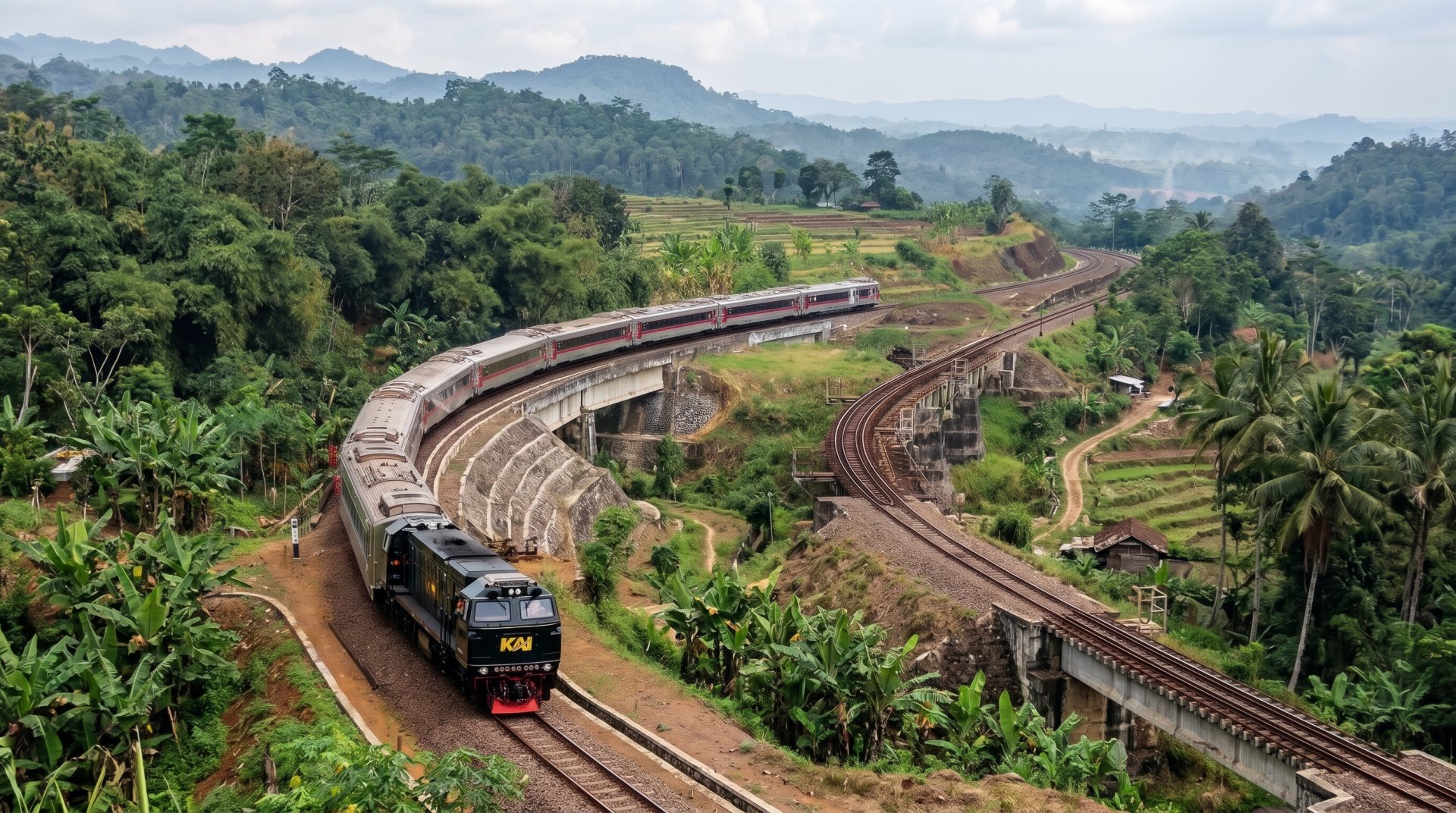
Beyond Cicalengka (where double-tracking from Haurpugur finished on December 30, 2024), single-track climbs through Nagreg and Lebakjero reach 25 permil (2.5%) gradients up to Cipeundeuy (+772 m asl) before descending steeply across the 100 m Trowek Bridge toward Cirahayu (+525 m asl). Since 2013, CC 206 (2,250 HP, 248 kN starting tractive effort, Westinghouse 26L dynamic+air brakes) has handled nearly 100% of Mutsel runs (with 0.3% CC 201 and 0.1% CC 203 substitutions), with a mandatory 10-minute brake-check stop at Cipeundeuy enforced strictly since the October 25, 1995 Trowek tragedy.

Class Builder & Model Trans. / Axle Power Weight / Axle Load Tractive Effort & Vmax
BB200GM-EMD / G8U6DE / (A1A)(A1A)950 HP75 t / light axle102.15 kN / 110 km/h
BB301Krupp / M1500BBDH / B'B'1,480–1,500 HP52 t / 13 t107.10 kN / 120 km/h
BB304Krupp / M1500BBDH / B'B'1,560 HP (repower 1,800)52 t / 13 t120 km/h
CC201GE / U18CDE / Co'Co'1,950 HP84 t / 14.2–14.6 t173.00 kN / 120 km/h
CC203GE & GELI / U20CDE / Co'Co'2,150 HP84 t / 14 t142.00 kN / 120 km/h
CC206GE / CM20EMPDE / Co'Co'2,250 HP90 t / 15 t248.00 kN (start) / 207 kN (cont.)

5. GAPEKA 2026 Schedule (KA 95/96), Fares & Competition

Effective December 1, 2026, KA Mutiara Selatan retains its historic name while shifting train numbers from KA 71/72 to KA 95 (Surabaya Gubeng 18:00 → Bandung 04:45, 10h 45m, −20 minutes vs. GAPEKA 2025, adding a new commercial stop at Jeruklegi 00:26–00:32 WIB for 21 total stops and 87 pass-throughs, driven by −7m savings on Cipeundeuy–Kiaracondong and −4m on Ciamis–Tasikmalaya) and KA 96 (Bandung 20:05 → Surabaya Gubeng 07:14, 11h 09m, +27 minutes vs. GAPEKA 2025, passing Jeruklegi at 00:30 while stopping 7 minutes at Nagreg 20:49–20:56 and 16 minutes at Kebumen 01:39–01:55). For travelers arriving in Bandung at 04:45 WIB, KA 95 offers an ideal early-morning arrival window, whereas KA 96's 07:14 WIB Surabaya arrival (32 minutes later than 06:42 in GAPEKA 2025) tightens margins for 08:00 AM business meetings.

Commercial Speed Competitiveness: Bandung–Surabaya & Jakarta–Surabaya
Average commercial speed (km/h) of KA Mutiara Selatan (GAPEKA 2026) vs. southern and northern rivals
KA Sembrani (Mutiara Utara Successor, 720 km) 85.1 km/h (8h 25–30m) KA Harina (North Coast, 730.6 km) 69.0 km/h (10h 30–50m) KA 95 Mutiara Selatan (SGU→BD, 696.3 km) 64.78 km/h (10h 45m) KA 96 Mutiara Selatan (BD→SGU, 696.3 km) 62.45 km/h (11h 09m) KA Pasundan (KAC–SGU, Eco NG Mod) ~52.5 km/h (~13 hrs)
Station (Code) KA 95 SGU→BD (2026) KA 71 (2025) KA 96 BD→SGU (2026) KA 72 (2025) Notes
Surabaya Gubeng (SGU)18:0018:1007:1406:42Terminus; CL Jatim
Mojokerto (MR)18:33–18:3518:45–18:4706:35–06:3806:05–06:09CL Dhoho & Jenggala
Jombang (JG)18:52–18:5419:05–19:0806:15–06:1705:43–05:46Regular PP stop
Kertosono (KTS)19:07–19:0919:21–19:2405:59–06:0205:27–05:30Kediri–Blitar branch
Nganjuk (NJ)19:26–19:2819:41–19:4405:40–05:4205:07–05:10Regular PP stop
Madiun (MN)20:01–20:0620:17–20:2205:02–05:0704:28–04:34KA BIAS airport rail
Solo Balapan (SLO)21:11–21:1521:27–21:3003:56–03:5903:21–03:24KRL Yogya–Solo
Yogyakarta (YK)21:58–22:0322:11–22:1603:10–03:1502:35–02:40KRL, Prameks, YIA
Kutoarjo (KTA)22:51–22:5423:02–23:0702:19–02:2401:45–01:50CL Prameks
Kebumen (KM)23:15–23:1723:27–23:2901:39–01:5501:25–01:27KA 96 16m dwell
Gombong (GB)23:33–23:3523:45–23:4701:21–01:2301:07–01:09Near Ijo Tunnel
Kroya (KYA)23:56–23:5900:09–00:1200:57–01:0000:42–00:45Purwokerto junction
Maos (MA)00:10–00:1400:24–00:3200:40–00:4600:28–00:30Cilacap branch
Jeruklegi (JRL)00:26–00:32PassPass (00:30)PassNew GAPEKA 2026 (KA 95)
Sidareja (SDR)00:55–00:5701:05–01:0700:05–00:0723:54–23:56Daop 5 Purwokerto
Banjar (BJR)01:21–01:2401:33–01:3723:35–23:4023:24–23:30East end of Daop 2
Ciamis (CI)01:45–01:4702:00–02:0223:12–23:1423:01–23:03Cirahong Bridge
Tasikmalaya (TSM)02:07–02:1302:26–02:2922:49–22:5222:37–22:40East Priangan hub
Cipeundeuy (CPD)02:56–03:0603:13–03:2321:57–22:0721:45–21:5510m mandatory brake check
Nagreg (NG)PassPass20:49–20:56PassKA 96 7m stop
Kiaracondong (KAC)04:34–04:3704:58–05:0520:14–20:1620:09–20:11CL Bandung Raya
Bandung (BD)04:4505:1520:0520:00Terminus; KCIC Feeder

Regular Economy Premium fares run Rp360,000–Rp460,000 (most commonly Rp410k–430k on OTAs, rising to Rp480k–500k during peak seasons) and Executive Rp530,000–Rp715,000 (Rp650k midpoint, Rp730k–760k peak), with partial segments such as Surabaya–Yogyakarta (Rp260k–290k Eco / Rp390k Exec) and Bandung–Yogyakarta (Rp345k Eco / Rp520k–550k Exec). For Dec 22, 2026–Jan 4, 2027, Commercial Economy receives a 30% Nataru stimulus discount (bookings open Nov 7, 2026–Jan 4, 2027). Post-Oct 12, 2026 Go-Show Special Fares (available 2 hours pre-departure) are detailed below. Positioned between SSNG-equipped Argo Wilis and Turangga (42–78 minutes faster in GAPEKA 2025 with Panoramic cars), northern-route Harina (730.577 km, 10h 30–50m), Pasundan (upgraded to 72-seat Economy NG Modified at Rp410k but taking ~13 hours, 2–3 hours slower), Malabar (2x PP Bandung–Malang via Kediri–Blitar, 779–780 km in 12–13 hours), and newcomer KA Sangkuriang (Bandung–Ketapang since May 1, 2026, 330,186 riders in 5 months, adding 6 stops in GAPEKA 2026), Mutiara Selatan remains backed by 97.31% national arrival OTP (Jan–Sept 2026) and 99.88% Daop 2 departure OTP (Q3 2026).

Go-Show Special Fare Corridor Post-Oct 12, 2026 Fare Previous 2025 Reference
Yogyakarta – Solo Balapan (PP)Exec: Rp65,000 | Eco: Rp55,000Exec: Rp55,000 | Eco: Rp45,000
Solo Balapan – Madiun (PP)Exec: Rp125,000 | Eco: Rp105,000Exec: Rp105–115k | Eco: Rp85–95k
Yogyakarta – Madiun (PP)Exec: Rp185,000 | Eco: Rp150,000Exec: Rp150,000 | Eco: Rp115,000
Surabaya Gubeng – Yogyakarta (PP)Daop 8 range: Exec up to Rp360k / Eco up to Rp205kExec: Rp255,000 | Eco: Rp135,000
Bandung – Tasikmalaya / Banjar (PP)Exec: Rp145,000 (aligned with Turangga/Lodaya/Malabar)BD–TSM: Rp120k/90k; BD–BJR: Rp130k/105k

6. Safety Record & Forensic Investigation Lessons (1974–2026)

Date Trains Involved Location Incident & Casualties Findings & Lessons
Jan 19, 1974KA B5 Mutiara Selatan vs KA S3 Bima ISoka Station, KebumenRear-end collision (BB301 15); 0 killed, 36 injured, Rp146.3M lossStationmaster (PPKA) failed to reset mechanical home signal (6-year prison sentence)
Mar 5, 1992KA Mutiara UtaraTegal Station121m dead-end siding overrun ("Mblandang Baen", BB304 15); 0 killed, 5 cars derailedMisrouted into dead-end siding instead of Track 1 pass-through
May 4, 1995KA 52 Mutiara SelatanMadiun Track 1 SwitchDerailment & overturn (CC201 06); 0 killed, 7 minor injuriesExcessive speed entering Track 1 turnout; halted southern line for days
Jan 28, 2011KA 103 Mutsel vs KA 174 Kutojaya SelatanLangen Station, BanjarHead-on collision (CC 203 11 vs CC 201 62); 3 killed, 26 injuredRed signal overrun + KNKT (KNKT/001/1/II/REK.KA/11) flagged non-standard signal display sightlines
Jan 1, 2023KA Mutiara SelatanPalur, Sukoharjo1 passenger fatality (fell from vestibule)Highlighted safety gap of manual vestibule doors vs. SSNG automatic doors
Apr 14, 2006 & Feb 4, 2026KA Sembrani (Mutiara Utara Successor)Gubug (2006) & Lamongan (2026)Gubug: 15 killed, 26 injured; Lamongan: 1 car fatalitySignal overrun by KA Kertajaya (2006) & level-crossing collision (2026)

Forensic Breakdown of Four Defining Incidents

1. Soka Tragedy (January 19, 1974): After KA 430's locomotive broke down on the main line, KA S3 Bima I was placed on the Soka siding and its locomotive detached to rescue KA 430. The stationmaster (PPKA) neglected to reset the Kebumen-side home signal to danger, causing KA B5 Mutiara Selatan (BB301 15) to enter the occupied siding and rear-end Bima I. Two Class I coaches (AW-9029 and AW-9039) were written off in 1976, losses reached Rp146.3 million, and the PPKA received a 6-year prison sentence.

2. Tegal "Mblandang Baen" Overrun (March 5, 1992): At 00:20 WIB, KA Mutiara Utara (BB304 15) was cleared to pass nonstop through Track 1 at Tegal Station, but was inadvertently routed into a 121-meter dead-end siding. The locomotive struck the buffer stop, derailing 5 of 10 coaches and smashing the station perimeter fence without fatalities.

3. Langen Station Head-On Collision (January 28, 2011): At 02:24 WIB, KA 103 Mutiara Selatan (CC 203 11) overran a red home signal at Langen and entered Track 3, colliding head-on with stationary KA 174 Kutojaya Selatan (CC 201 62, 420 passengers), killing 3 passengers in Kutojaya's leading coach and injuring 26. Academic studies citing KNKT report KNKT.11.01.01.02 (recommendation KNKT/001/1/II/REK.KA/11) revealed that the signal display's dimensions, viewing distance, and angle failed standard visibility criteria.

4. Sukoharjo Vestibule Fatality (January 1, 2023) & 2026–2029 Outlook: A passenger's fatal fall after opening a manual vestibule door near Palur underscores why upgrading to automated SSNG sliding doors (from the remaining 221-coach INKA contract through 2027) is vital for safety alongside comfort. Meanwhile, Mutiara Selatan's 62.45–64.78 km/h commercial speed has reached its infrastructure ceiling on the single-track East Priangan mountain line—awaiting long-term double-tracking across Cicalengka–Tasikmalaya–Banjar–Kroya outlined in DJKA's 2025–2029 Strategic Plan.
Key Takeaways & Assistive Q&A
What happened to KA Mutiara Utara vs. KA Mutiara Selatan?
KA Mutiara Utara (1971–1995) was retired in October 1995 and replaced by KA Sembrani, whereas KA Mutiara Selatan (launched August 17, 1972) has operated for over 54 years as Indonesia's second-oldest passenger train retaining its original name after KA Bima.
How does KA Mutiara Selatan change in GAPEKA 2026?
Effective December 1, 2026, it renumbers from KA 71/72 to KA 95/96. Westbound KA 95 (Surabaya Gubeng 18:00–Bandung 04:45) cuts 20 minutes and adds a stop at Jeruklegi, while eastbound KA 96 (Bandung 20:05–Surabaya Gubeng 07:14) adds 27 minutes with stops at Nagreg and Kebumen.
Does KA Mutiara Selatan regularly use Stainless Steel New Generation (SSNG) coaches?
No. Official Daop 8 PPID schedules and PT KAI's June 2026 612-coach INKA contract report confirm regular sets still run Stainless Steel Generation 1 (SSG1) coaches with 520 seats (4 K1 + 4 K3 Premium), rotating sets with morning KA Harina.
Why must KA Mutiara Selatan stop for 10 minutes at Cipeundeuy Station?
Situated at +772 m asl atop the East Priangan mountain line, Cipeundeuy precedes steep descents toward Cirahayu. The mandatory 10-minute brake inspection was strictly reinstated after the October 25, 1995 Trowek derailment.
What are the regular and 2026/2027 Nataru fares for KA Mutiara Selatan?
Regular Economy Premium fares range from Rp360,000–Rp460,000 and Executive from Rp530,000–Rp715,000. For Dec 22, 2026–Jan 4, 2027 departures, Commercial Economy receives a 30% Nataru stimulus discount.

Related Dispatches

History & Status of Indonesia's Argo Class: From 1995 Pioneers to Gapeka 2026
History, Analysis

History & Status of Indonesia's Argo Class: From 1995 Pioneers to Gapeka 2026

KA Argo Wilis: History, Southern Line Engineering, SSNG Fleet & GAPEKA 2026 Status
History, Train Profile

KA Argo Wilis: History, Southern Line Engineering, SSNG Fleet & GAPEKA 2026 Status

History & Profile of KA Bima (1967–2026): Night Blue Legend to Suite Class & GAPEKA 2026
History, Train Profile

History & Profile of KA Bima (1967–2026): Night Blue Legend to Suite Class & GAPEKA 2026

alurail alurail
Copyright ©️ 2024-2026 alurail by alula Made with 💗 from Pejaten, ID
Copyright ©️ 2024-2026 alurail by alula
Made with 💗 from Pejaten, ID

Community & Photographers

  • alurail Pass PRO
  • Submit Photo
  • User Suite
  • Curated Feed
  • Community Feed

Platform & Legal

  • About Platform
  • Terms & Conditions
  • Privacy Policy
  • Open Source Notices
  • FAQ / Help Center
Pass PRO PRO Upload Photo Suite Gallery
About
Terms
Privacy
License
FAQ
© 2026 alurail. All rights reserved.
alurail

alurail Legal & Info

About alurail

<h2>About AluRail</h2>

<p class="lead">
AluRail (Aluline TGV) is a free web-based platform that visualizes railway operations and train travel schedules across Indonesia. The service is available through <a href="https://alurail.web.id" target="_blank">alurail.web.id</a> and <a href="https://alurail.web.id" target="_blank">alurail.web.id</a>, developed independently by <strong>Alula</strong>
(<a href="https://alula.web.id" target="_blank">alula.web.id</a>) for railway enthusiasts (railfans) and passengers seeking a more intuitive understanding of train movements and timetable operations.
</p>

<h3>How It Works</h3>

<p>
AluRail transforms official <strong>GAPEKA 2025</strong> (Indonesia Railway Timetable Graph) data into an interactive geospatial visualization. Every train journey is reconstructed from scheduled departure and arrival times, station sequences, railway topology, and routing calculations to estimate how trains would move across the network.
</p>

<p>
Unlike conventional timetable viewers, AluRail continuously simulates train movement using a custom railway physics engine. The simulation considers various operational parameters including route geometry, train acceleration, braking, cruising speed, station dwell times, operational constraints, and other physical assumptions to estimate each train's position throughout its journey.
</p>

<p>
Whenever available, the platform also supports <strong>Crowdsourced Live Tracking</strong>. Passengers currently travelling on board may voluntarily share their GPS location. These telemetry reports are validated using map-matching algorithms and compared against the predicted GAPEKA route before being displayed to other users.
</p>

<h3>The Technology Behind AluRail</h3>

<ul>
<li><strong>PostgreSQL (PostGIS):</strong> Serves as the core geospatial database storing railway infrastructure, stations, and spatial relationships.</li>

<li><strong>Custom Railway Routing Engine:</strong> Implements graph-based routing algorithms including Dijkstra and A* to calculate railway paths, station connectivity, and operational routes.</li>

<li><strong>Railway Physics Engine:</strong> Simulates train movement by modelling acceleration, deceleration, cruising behaviour, station stops, speed restrictions, and travel progression based on timetable data.</li>

<li><strong>Viterbi Map-Matching:</strong> Validates crowdsourced GPS telemetry by matching noisy GPS observations onto the most probable railway track, improving live tracking reliability.</li>

<li><strong>Leaflet.js & OpenRailwayMap:</strong> Provide interactive map rendering and railway visualization layers.</li>
</ul>

<h3>Supported Railway Services</h3>

<p>
AluRail supports visualization for various railway services operating across Indonesia, including passenger, commuter, urban transit, heritage, and freight operations. Depending on data availability, the platform currently supports:
</p>

<ul>
<li>Intercity Passenger Trains (KA Antar Kota)</li>
<li>Whoosh High-Speed Railway</li>
<li>Commuter Line</li>
<li>Feeder Train Services</li>
<li>Local Passenger Trains</li>
<li>Freight Operations (Container, Cargo, Tanker, Coal, Cement and other freight services)</li>
<li>LRT Jakarta</li>
<li>LRT Jabodebek</li>
<li>LRT South Sumatra (Palembang)</li>
<li>Jakarta MRT</li>
<li>Ambarawa Heritage Railway</li>
</ul>

<p>
Additional railway operators and future services may be introduced as more infrastructure and timetable data become available.
</p>

<h3>Platform Features</h3>

<p>
AluRail combines timetable simulation, geospatial analysis, and live community participation into a single railway visualization platform. Key features include:
</p>

<ul>

<li>
<strong>Follow Mode</strong><br>
Automatically follows a selected train throughout its journey while continuously updating its estimated or live position.
</li>

<li>
<strong>Live GPS Cast</strong><br>
Passengers may voluntarily broadcast GPS telemetry while travelling onboard, allowing supported trains to display verified live positions instead of purely simulated movement.
</li>

<li>
<strong>Spotting Mode</strong><br>
Allows railfans to discover trains approaching nearby stations or railway crossings, making it easier to plan photography and train spotting activities.
</li>

<li>
<strong>Enhanced Railway Physics</strong><br>
Movement simulation considers railway gradient, elevation profile, track curvature, acceleration, braking, traction performance, speed restrictions, and operational constraints to produce more realistic train behaviour.
</li>

<li>
<strong>Detailed Route Analytics</strong><br>
Provides interactive charts including route elevation, curvature, gradient between stations, speed profile, and operational characteristics throughout the journey.
</li>

<li>
<strong>Train Information</strong><br>
Displays operational information about each service including operator, train category, route, schedule, formation details, and other service information.
</li>

<li>
<strong>Rolling Stock Database</strong><br>
Provides information about locomotives, EMUs, DMUs, coaches, wagons, and other railway vehicles used by supported services.
</li>

<li>
<strong>Coach & Class Information</strong><br>
Displays available passenger classes together with reference illustrations where available to help passengers identify onboard accommodation.
</li>
<li>
<strong>Adaptive Train Rendering</strong><br>
Train visualization automatically adjusts according to the current map zoom level. Different rendering modes are used to maintain smooth performance while displaying thousands of simultaneously simulated trains.
</li>

<li>
<strong>Train Filtering</strong><br>
Filter trains by service category such as Intercity, Commuter, High-Speed, Metro, LRT, Freight, Heritage, and other supported railway services.
</li>

<li>
<strong>Regional Filtering</strong><br>
Display trains operating within selected operational regions (Daerah Operasi / DAOP and other railway operational divisions) for easier monitoring.
</li>

<li>
<strong>Points of Interest (POI)</strong><br>
Explore railway-related locations including train spotting locations, photography viewpoints, railway landmarks, bridges, tunnels, stations, and other notable locations along the railway network.
</li>

<li>
<strong>Depots & Maintenance Facilities</strong><br>
View railway maintenance facilities including rolling stock depots, locomotive depots, maintenance workshops (Balai Yasa), stabling yards, and other operational infrastructure.
</li>

</ul>

<div class="disclaimer-box">
<h4>Disclaimer</h4>

<p>
<strong>AluRail is primarily a timetable simulation platform.</strong>
Unless a train is actively sharing verified Live Tracking data, all train positions displayed on the map are computational estimations generated from published schedules and the platform's railway physics engine.
</p>

<p>
Although the simulation attempts to realistically reproduce railway operations, actual train movements may differ significantly due to dispatching decisions, signal aspects, operational priorities, temporary speed restrictions, maintenance work, weather conditions, delays, early departures, extraordinary operations, GPS inaccuracies, or many other real-world factors that cannot always be observed by the platform.
</p>

<p>
Even when Live Tracking is available, GPS accuracy depends on user participation, mobile device quality, satellite reception, and local environmental conditions. Therefore, displayed positions should always be considered informational rather than authoritative.
</p>

<p>
<strong>This service must not be used as an official operational reference</strong> for travel planning, ticketing decisions, passenger information, or railway operations. Always refer to official PT Kereta Api Indonesia (Persero) information channels for accurate operational updates.
</p>

<p>
AluRail / Aluline TGV is an independent community project and is not affiliated with, endorsed by, partnered with, or officially associated with PT Kereta Api Indonesia (Persero), OpenStreetMap, OpenRailwayMap, or any other referenced organizations.
</p>
</div>

<p class="footer-note">
Made with ❣️ from Pejaten, Indonesia.
</p>

Terms of Use

<section id="terms-en" class="lang-content">
<h2>Terms of Service</h2>
<p class="effective-date"><strong>Effective Date:</strong> January 1, 2025 (Updated for GAPEKA 2025)</p>

<h3>1. Acceptance of Terms</h3>
<p>By accessing AluRail through alurail.web.id, alurail.web.id, and related subdomains (collectively, the "Service"), you acknowledge that you have read, understood, and agreed to these Terms of Service. If you do not agree, you must discontinue use of the Service.</p>

<h3>2. Independent Service</h3>
<p>AluRail is an independent community project developed by Alula. It is not affiliated with, endorsed by, or operated by any railway operator, government agency, or transportation authority unless explicitly stated.</p>

<h3>3. Nature of the Service</h3>
<p>The Service provides train schedule visualization, estimated train positions, operational simulations, and crowdsourced location validation based on publicly available information, GAPEKA data, and algorithmic processing. Displayed information may differ from actual railway operations.</p>

<h3>4. No Operational Guarantee</h3>
<p>Train movements, schedules, platform assignments, delays, cancellations, dispatching decisions, and operational conditions may change without notice. The Service must not be considered an official operational information source.</p>

<h3>5. Crowdsourced Contributions</h3>
<p>Users may voluntarily contribute GPS telemetry while onboard trains. Submission of fake GPS data, manipulated locations, automated submissions, spam, or attempts to interfere with system accuracy is strictly prohibited.</p>

<h3>6. Acceptable Use</h3>
<p>You agree not to misuse the Service, interfere with its infrastructure, reverse engineer protected components, exploit security vulnerabilities, scrape excessive data, or use automated systems that negatively impact platform availability.</p>

<h3>7. Intellectual Property</h3>
<p>Unless otherwise stated, the Service, its software, interface, branding, and original content remain the intellectual property of their respective owners. Open-source components remain governed by their own licenses.</p>

<h3>8. Availability</h3>
<p>The Service may be modified, suspended, restricted, or discontinued at any time without prior notice.</p>

<h3>9. Disclaimer ("AS IS")</h3>
<p>THE SERVICE IS PROVIDED "AS IS" AND "AS AVAILABLE" WITHOUT WARRANTIES OF ANY KIND, EXPRESS OR IMPLIED, INCLUDING MERCHANTABILITY, FITNESS FOR A PARTICULAR PURPOSE, NON-INFRINGEMENT, ACCURACY, OR CONTINUOUS AVAILABILITY.</p>

<h3>10. Limitation of Liability</h3>
<p>To the fullest extent permitted by law, Alula shall not be liable for direct, indirect, incidental, consequential, special, or punitive damages arising from the use of or inability to use the Service, including travel decisions, delays, missed connections, financial loss, personal injury, or data loss.</p>

<h3>11. Changes to these Terms</h3>
<p>These Terms may be updated periodically. Continued use of the Service constitutes acceptance of the revised Terms.</p>

<h3>12. Contact</h3>
<p>Questions regarding these Terms may be directed through the official AluRail contact channels.</p>
</section>

<h3>Independent Service Disclaimer</h3>

<p>AluRail is an independent community-developed platform created by Alula for railway visualization, research, educational, and enthusiast purposes.</p>

<p>AluRail is <strong>not affiliated with, associated with, authorized by, endorsed by, sponsored by, supported by, maintained by, operated by, or officially connected with</strong> PT Kereta Api Indonesia (Persero), PT Kereta Commuter Indonesia, PT Kereta Api Logistik, PT Kereta Api Pariwisata, PT Kereta Cepat Indonesia China (Whoosh), MRT Jakarta, LRT Jabodebek, LRT Jakarta, LRT Sumatera Selatan (Palembang), their subsidiaries, affiliates, successors, government agencies, transportation authorities, or any other railway operators unless explicitly stated.</p>

<p>All company names, railway service names, station names, train names, logos, trademarks, service marks, brands, route names, and other intellectual property displayed within the Service remain the property of their respective owners and are used solely for identification, informational, interoperability, historical, mapping, educational, or descriptive purposes.</p>

<p>The visualization presented by the Service represents publicly available operational information, algorithmic estimations, historical references, and voluntary community contributions. It must not be interpreted as an official operational system, railway dispatching platform, passenger information system, or real-time control center operated by any railway company.</p>

Privacy Policy

<section id="privacy-en" class="lang-content">
<h2>Privacy Policy</h2>
<p class="effective-date"><strong>Last Updated:</strong> June 2026</p>

<h3>1. Privacy Commitment</h3>
<p>Your privacy is important to us. We collect only the information reasonably necessary to operate and improve the Service.</p>

<h3>2. GPS Collection</h3>
<p>Your GPS location is accessed only after you intentionally enable Live Tracking. Background location is never collected without your explicit action.</p>

<h3>3. Processing</h3>
<p>Submitted GPS telemetry is processed using routing algorithms including Viterbi matching against the railway network to validate train positions. Telemetry is not associated with your personal identity.</p>

<h3>4. Server Logs</h3>
<p>Standard server logs such as IP address, browser type, timestamps, and technical diagnostics may be collected for security, abuse prevention, troubleshooting, and performance monitoring.</p>

<h3>5. Data Retention</h3>
<p>Live telemetry is temporary and automatically expires after the associated trip ends unless longer retention is required for security investigations.</p>

<h3>6. Third Parties</h3>
<p>We do not sell or rent your GPS telemetry. Limited technical processing by infrastructure providers may occur solely for operating the Service.</p>

<h3>7. Security</h3>
<p>Reasonable technical and organizational safeguards are implemented, although no online system can guarantee absolute security.</p>

<h3>8. User Safety</h3>
<p>We discourage publicly sharing real-time GPS positions. Anonymous mode or pseudonyms are strongly recommended.</p>

<h3>9. Your Responsibility</h3>
<p>Use of Live GPS or spotting features is entirely voluntary and at your own risk.</p>
</section>

Open Source Notices

<section id="opensource-en" class="lang-content">
<h2>Open Source Notice</h2>
<p>AluRail is built upon numerous open-source technologies and open data projects. We sincerely thank the communities maintaining them.</p>
<ul>
<li><strong>PostgreSQL, PostGIS & pgRouting</strong> — Spatial database, GIS extension, and routing engine.</li>
<li><strong>OpenStreetMap & OpenRailwayMap</strong> — Railway infrastructure and mapping data under their respective licenses.</li>
<li><strong>Leaflet.js</strong> — Interactive mapping library.</li>
</ul>
<p>All trademarks, copyrights, and licenses belong to their respective owners. Use within AluRail does not imply endorsement by those projects.</p>
</section>

alurail for Android

Version 1.3.0 • APK (110 MB)

Download the official alurail app package for Android.

Download APK
Requires Android 8.0 (Oreo) or later
alurail Pass Prime GRATIS!
early access

alurail Pass Prime GRATIS!